
Blog
How to Build a B2B Lifecycle Email Programme for a Long Sales Cycle
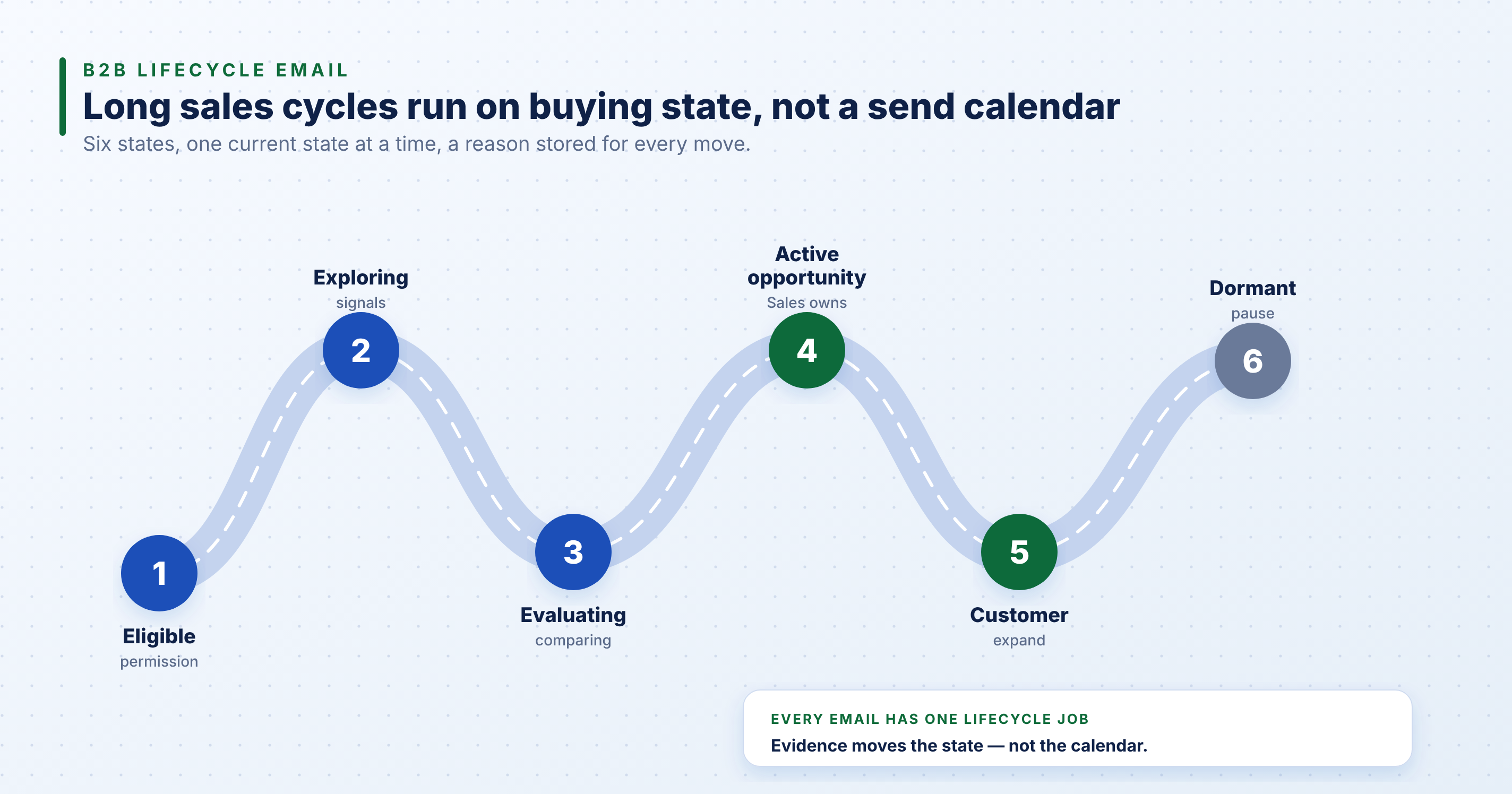
The best B2B lifecycle email programme for a long sales cycle is built around changes in buying state—not a fixed calendar of promotional sends.
That means defining who is eligible, what the business knows, what changed, which message is useful now, when Sales should take over and when communication should stop.
A long sales cycle is not one extended nurture sequence. It contains distinct periods of research, evaluation, internal alignment, commercial review, inactivity and re-entry. The same contact can move forward, pause, return with a colleague or become part of an active opportunity.
The programme should respond to those changes without pretending every email caused the next revenue event.
Why long sales cycles change email strategy
In a short transactional journey, a sequence can reasonably focus on one person moving toward one purchase.
In a complex B2B journey:
- Several people may research at different times.
- The original contact may not become the opportunity contact.
- Sales conversations and marketing emails can overlap.
- Intent can rise and disappear more than once.
- Budget or timing may pause a valid opportunity.
- A customer, partner or former employee can remain in a prospect segment if CRM data is weak.
A simple “day 1, day 3, day 7” sequence treats elapsed time as though it were buyer progression.
Elapsed time matters, but the more useful question is: What is true about this person, account and opportunity now?
Lifecycle email works when the CRM can answer that question consistently.
Define six lifecycle states before writing emails
The labels can vary, but the operating differences should be explicit.
| Lifecycle state | What it means | Typical email job | Exit or suppression signal |
|---|---|---|---|
| Eligible | Contact can receive marketing and fits minimum rules | Confirm interest or begin education | Ineligible, unsubscribed, invalid or suppressed |
| Exploring | Early research without an active buying process | Explain the problem and useful options | Stronger intent, meeting, inactivity |
| Evaluating | Repeated relevant engagement or known project | Help compare approaches and involve the buying group | Sales acceptance, opportunity, disqualification |
| Active opportunity | Sales owns a live commercial process | Support the deal only where coordinated | Closed won, closed lost, stalled or no decision |
| Customer | Commercial relationship exists | Onboarding, adoption, expansion or advocacy | Churn or account change |
| Dormant or recycled | Previously relevant but not active now | Re-engage with a new reason, not endless reminders | Renewed engagement, explicit no, expiry |
Do not use lifecycle stage as a decorative CRM field. Each state should control eligibility, content, cadence, ownership and measurement.
If the same email programme treats an early researcher, open opportunity and customer identically, the problem is not copy. It is lifecycle architecture.
Eight operating rules for the programme
1. Separate permission from commercial relevance
A contact can be legally or contractually eligible to receive email and still be commercially irrelevant to the programme.
Use two gates:
- Communication eligibility: consent, subscription status, valid address, suppression and applicable legal basis.
- Programme eligibility: segment, role, account status, opportunity status, product interest and lifecycle state.
Passing the first gate does not automatically justify every message.
2. Use one current state and preserve the history
The CRM should hold the contact's current lifecycle state and a dated history of meaningful transitions.
Without history, the team cannot distinguish a person who has always been early-stage from somebody recycled after an opportunity. Those journeys deserve different communication.
3. Treat the account as context, not just the contact
Before enrolling a contact, check the company and opportunity context.
Someone may appear inactive while a colleague is in an active sales process. A new contact at a customer account may not belong in acquisition nurture. An account can also contain different business units with different relationships, so account suppression needs deliberate scope.
4. Give every email one lifecycle job
An email should help the reader do one useful thing:
- Understand a problem
- Evaluate approaches
- Build an internal case
- Involve another stakeholder
- Prepare for a conversation
- Resolve a common risk
- Reconsider after a meaningful change
Trying to educate, qualify, book a demo and announce three features in the same email makes both the message and measurement unclear.
5. Trigger on evidence, not every available signal
Page views, downloads, email clicks, product use and third-party intent have different reliability.
Define which signals can change the programme, how recent they must be, whether multiple signals are required and which exclusion rules take priority.
A pricing-page visit can justify a more relevant follow-up. It should not automatically prove purchase intent or authorise aggressive sales contact.
6. Set a maximum pressure, not only a send schedule
Frequency is created across the whole company, not within one workflow.
A contact may receive a newsletter, event promotion, nurture, sales sequence and customer communication in the same week. Build a shared frequency and priority rule so the most important message wins.
7. Make inactivity an explicit state change
Do not leave contacts in an endless programme because no one defined an expiry.
Set an inactivity window appropriate to the sales cycle. Move the person into a lower-frequency or dormant state. Re-entry should require new evidence, not simply the next calendar date.
8. Store the reason for every meaningful transition
“Lifecycle stage changed” is not enough for diagnosis.
Record the rule or event: meeting booked, opportunity created, customer confirmed, inactivity threshold reached, intent renewed, manual review or data correction.
That history helps Marketing Operations explain why the person received a message and why the programme stopped.
Deliverability and permission are programme design inputs
Deliverability cannot be repaired only at send time.
Google's current sender guidance emphasises authentication, low spam rates, easy unsubscribing and appropriate message practices. M3AAWG guidance similarly treats permission, complaint management and list quality as ongoing operating disciplines.
For lifecycle programmes, that means:
- Authenticate the sending domain correctly.
- Use visible, functioning unsubscribe and preference controls.
- Suppress invalid, unsubscribed and complaint records everywhere—not only in one list.
- Avoid reactivating old records solely because an enrichment tool found a new address.
- Monitor complaint, bounce and engagement trends by programme and acquisition source.
- Protect the main domain from experiments that have unclear permission or provenance.
An address that can technically receive a message is not automatically an address the company should use.
Use behavioural data carefully
Email opens are not a dependable intent signal on their own.
Apple Mail Privacy Protection can download remote content in ways that affect open measurement. Security scanners and automated systems can also interact with links. Platform-specific filters help, but they do not turn every engagement event into human buying intent.
Use stronger evidence where possible:
- Direct replies
- Meeting creation
- Form submissions with meaningful context
- Repeated high-value website activity
- Known event attendance
- Product or trial actions
- Account-level activity from several relevant people
Treat one weak signal as a reason to observe or adjust content—not as proof that Sales should act immediately.
Coordinate email with Sales ownership
The transition to Sales should not produce either silence or duplicate outreach.
Define what happens when a contact or account becomes sales-owned:
- Which marketing messages continue because they support evaluation?
- Which promotional or automated sequences stop?
- Can the seller pause, resume or request a programme?
- Which messages and responses are visible in the CRM?
- Who owns follow-up after a reply?
- What happens when the opportunity stalls or closes with no decision?
For long cycles, Marketing may continue providing useful evidence while Sales owns the relationship. The goal is coordination, not total disappearance.
Test the journey, not just the email
Subject-line and content tests matter, but the larger risks often sit in the programme logic.
Test whether:
- The right records enrol
- Customers and active opportunities are handled correctly
- Consent and suppression changes remove a record
- Account and opportunity relationships are considered
- A meeting or reply changes the journey
- Frequency rules work across programmes
- Re-entry and expiry behave as intended
- Reporting captures both enrolment and outcome
Use test records for normal, excluded, boundary and reversal cases. A workflow is not complete until removal has been tested.
Measure at three levels
| Level | What to measure | What it tells you |
|---|---|---|
| Delivery and eligibility | Delivery, bounce, complaint, unsubscribe, suppression and reachable audience | Whether the programme can reach the intended population responsibly |
| Engagement and progression | Click, reply, meeting, high-value action and lifecycle transition | Whether recipients are taking useful next steps |
| Commercial contribution | Accepted opportunities, pipeline association, progression and customer outcomes | Whether the programme appears in meaningful revenue journeys |
Do not let opens dominate the scorecard. They can support diagnostics, but they are not a commercial outcome.
Also separate programme health from attribution. A contact who received nurture before creating an opportunity shows an observed relationship. It does not prove that the emails caused the opportunity. Use holdouts or phased tests when the company needs a stronger causal answer.
A practical 30-day build plan
Week 1: Define lifecycle states, ownership, entry/exit rules and global suppression. Audit current programmes and identify conflicts.
Week 2: Build the CRM fields, history, account and opportunity checks, subscription rules and frequency controls. Agree the Sales handoff and return path.
Week 3: Create a small content set for the most important states. Each email should have one lifecycle job and a clear measurement event.
Week 4: Test complete journeys with realistic records, launch to a limited cohort and review exceptions, deliverability and progression weekly.
Add sophistication only after the basic state changes are trustworthy.
The Structured GTM position
A good lifecycle email programme does not win by sending the most messages or building the longest sequence.
It wins by making communication appropriate to the buyer's current state, coordinated with Sales, safe for the sending reputation and measurable in the CRM.
Start with lifecycle architecture. Add content to serve each state. Use automation to execute the rules and reporting to learn where people move, stall or leave.
The right question is not “Which email comes next?”
It is “What changed—and what communication is useful now?”
Structured GTM can help define the lifecycle, configure the CRM and build the email, suppression and reporting logic that keeps a long-cycle programme useful.
Sources and further reading
- Structured GTM solutions — accessed 23 October 2026. Used for service mapping.
- DMA: Marketer Email Tracker 2026 — 25 March 2026. Industry survey; methodology and membership context should remain visible.
- DMA, “From Opens to Outcomes” — 7 July 2026. Used to support outcome-led email measurement; industry guidance rather than causal evidence.
- DMA Email Benchmarking Report — 9 July 2026. Aggregate benchmarks should not be treated as targets for every B2B programme.
- Google: Email sender guidelines — current documentation. Authentication, spam-rate and unsubscribe requirements can change.
- M3AAWG sender best practices — 27 August 2026 material reviewed. Industry guidance on permission, complaints and list quality.
- Apple: Mail Privacy Protection — current documentation. Supports the caveat that opens are not always direct human actions.
- HubSpot: Create and send marketing emails — updated 14 July 2026. Platform capability and configuration, not market evidence.
- HubSpot: Email health — updated 22 September 2026. Product metrics and thresholds are HubSpot-specific.
- HubSpot personalisation guidance — updated 5 October 2026. Used for implementation context; personalisation does not replace lifecycle relevance.